So, Dumpster diving has been in the news a bit recently, mostly due to this NYT expose on Dumpster diving and freegan culture.
This reminded me of an idea I had a while ago for a blog post that was never actually written - so here it is:
During the planning and early discussion phase of this trip (i.e. last summer), we managed to generate a large portion of the financing for our voyage through Dumpster Diving.
In Madison, every August 15th is called "moving day" because of the very large number of annual (student) leases that expire. On August 15, a large number of people move in and out of apartments. As a result, the streets fill with trash and Dumpster Divers looking for good junk.
Madison (like most Midwestern cities) has a disproportionately large number of propane and charcoal grills - many of which find themselves homeless around August 15 or so. We drove around in my pickup truck, grabbed grills of the street, fixed them up with new hardware and paint as necessary, and sold them for a profit. I think we sold somewhere in the range of 6-7 propane grills and 3-4 charcoal grills, investing about $50-$60 total in paint and hardware, and earning about $50-$75 per grill.
It was a lot of fun-repairing grills appeals to my engineering sensibilities, and I liked diverting a significant chunk of metal and plastic from the landfill. On one (sadly unsalvageable) grill, I even found a mostly full tank of propane (worth ~$40)! Had that tank gone to the landfill, it could have caused damage to the environment, landfill equipment, and may have endangered the safety of sanitation workers!
Some interesting reading:
"On Dumpster Diving" by Lars Eighner
I read this for my English 101 class - a great story discussing the mechanics of Dumpster Diving, possibly one of the progenitors of the Freegan movement. Highly recommended reading - will change how you view waste.
Dumpster Diving Wikipedia Article
Is there anything Wikipedia doesn't know? This is article's funnily dry approach to Dumpster Diving has a lot of information, and even a few good links at the bottom.
Showing posts with label Environment. Show all posts
Showing posts with label Environment. Show all posts
Saturday, June 23, 2007


Thursday, May 17, 2007
Algae in the desert: CEHMM
About a week and a half ago, we visited the wonderful folks at CEHMM, shot an hour and a half of video, saw their research, and generally had a good time. Here are my notes:
We drove into Carlsbad, New Mexico, a little mining and oil town in southeastern New Mexico surrounded by high desert. This humble location is home to one of the world's few algae-based biofuels research organizations.
CEHMM (pronounced "chem" - the Center of Excellence for Hazardous Materials Management) is a research organization whose primary aim is to protect human and environmental health while advancing economic development of the area. If they are successful in their algae work, they will certainly have achieved this goal.
Producing biodiesel from algae requires 4 basic steps:
Growing algae is the easy part - algae requires sunlight, water, nutrients, carbon dioxide, and some way to protect the purity and health of the algae.
30 miles north of Carlsbad, in Artesia, NM, on the grounds of New Mexico State University's agricultural research station, reside CEHMM's test ponds. To protect their algae, they are using saltwater algae in a brine - the brine water protects the algae from intruders and keeps the strain fairly pure.
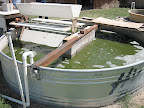
Here is a photo of test pond #1: the paddle wheel both agitates and aerates the algae - providing it with atmospheric CO2.
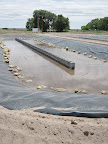
And here is a photo of the soon to be completed 1/8 acre test pond:
2. Harvesting
These algae ponds reach about 1 gram of (useful) biomass per liter of (useless) water. Getting rid of the water is a difficult step. There are many methods of harvesting algae (see this Wikipedia article on algaculture for other ideas), CEHMM is using a proprietary technology that involves membranes (think: very fine mesh filters that don't clog) to create a very concentrated mixture of water and algae.
3. Extracting
If harvesting is difficult, extracting is extremely difficult. This step is again proprietary (darn NDAs), and I was only given hand-waving explanations of how CEHMM accomplishes this bit. They are apparently looking at two competing technologies - one is able to produce biodiesel directly from the harvested algae by melting cell membranes, etc. I have no idea what other products are made in this process.
Another process they are looking at involves separating the oil from the cell membranes (which can then be composted, used as fertilizer, fed to animals, etc).
4. Processing
If CEHMM chooses to go with the second of the two extraction methods, they will have to process the resulting oil into biodiesel. In a retired gas station in Carlsbad, NM CEHMM has a small scale biodiesel production facility. Here is where they experiment with biodiesel production techniques (and fill up the local fire department with the resulting fuel).
Here is Terry showing off the second ever batch of biodiesel produced from algae. "A group in New Zealand beat us by a week."

I can't wait to see the fruits of CEHMM's research, it is my hope that in the not too distant future, many of us will be driving around on algae-produced biodiesel.
We drove into Carlsbad, New Mexico, a little mining and oil town in southeastern New Mexico surrounded by high desert. This humble location is home to one of the world's few algae-based biofuels research organizations.
CEHMM (pronounced "chem" - the Center of Excellence for Hazardous Materials Management) is a research organization whose primary aim is to protect human and environmental health while advancing economic development of the area. If they are successful in their algae work, they will certainly have achieved this goal.
Producing biodiesel from algae requires 4 basic steps:
- Growing the algae
- Harvesting (separating water from algae)
- Extracting the oil from the algae
- Processing the oil into biodiesel
Growing algae is the easy part - algae requires sunlight, water, nutrients, carbon dioxide, and some way to protect the purity and health of the algae.
30 miles north of Carlsbad, in Artesia, NM, on the grounds of New Mexico State University's agricultural research station, reside CEHMM's test ponds. To protect their algae, they are using saltwater algae in a brine - the brine water protects the algae from intruders and keeps the strain fairly pure.
Here is a photo of test pond #1: the paddle wheel both agitates and aerates the algae - providing it with atmospheric CO2.
And here is a photo of the soon to be completed 1/8 acre test pond:
2. Harvesting
These algae ponds reach about 1 gram of (useful) biomass per liter of (useless) water. Getting rid of the water is a difficult step. There are many methods of harvesting algae (see this Wikipedia article on algaculture for other ideas), CEHMM is using a proprietary technology that involves membranes (think: very fine mesh filters that don't clog) to create a very concentrated mixture of water and algae.
3. Extracting
If harvesting is difficult, extracting is extremely difficult. This step is again proprietary (darn NDAs), and I was only given hand-waving explanations of how CEHMM accomplishes this bit. They are apparently looking at two competing technologies - one is able to produce biodiesel directly from the harvested algae by melting cell membranes, etc. I have no idea what other products are made in this process.
Another process they are looking at involves separating the oil from the cell membranes (which can then be composted, used as fertilizer, fed to animals, etc).
4. Processing
If CEHMM chooses to go with the second of the two extraction methods, they will have to process the resulting oil into biodiesel. In a retired gas station in Carlsbad, NM CEHMM has a small scale biodiesel production facility. Here is where they experiment with biodiesel production techniques (and fill up the local fire department with the resulting fuel).
Here is Terry showing off the second ever batch of biodiesel produced from algae. "A group in New Zealand beat us by a week."

I can't wait to see the fruits of CEHMM's research, it is my hope that in the not too distant future, many of us will be driving around on algae-produced biodiesel.
Monday, April 30, 2007
Recycling
The more we travel, we realize that we were spoiled. In Madison, recycling was convenient - we easily recycled all of our aluminum, plastic, glass, paper and cardboard in a city provided container every other week on the curbside. Most cities we have visited do not provide this convenience and we have found that most items that could be recycled are thrown in the trash.
Recycling reduces the energy and raw materials for production and reduces waste going to landfills. Some examples:
- Aluminum made from recycled aluminum instead of raw ore requires 95% less energy.
- Recycling 1 ton of plastic reduces CO2 emissions by about 1 ton.
-Between 2-4 barrels of oil is saved by recycling 1 ton of paper.
http://www.nrdc.org/cities/recycling/recyc/recytbls.asp
Two methods of recycling exist:
Curbside Pickup:
Pro: Convenient for residents, More material gets recycled
Con: Costly for taxpayers
Drop-off Recycling Center:
Pro: Inexpensive for taxpayers
Con: Less material gets recycled, Inconvenient
Several hard items to recycle are batteries, electronics, and tires and they need to be taken to special locations. While traveling, we saw that Savannah sets up a tent for hard to recycle items at their annual Earth Day Celebration. I thought that was such a convenient process for recycling.
Two good recycling guides are:
-This site has more information about what and why we should recycle.
http://www.recycling-guide.org.uk/
-This site will help you find out what is available in your city.
http://www.earth911.org/static.html
Recycling reduces the energy and raw materials for production and reduces waste going to landfills. Some examples:
- Aluminum made from recycled aluminum instead of raw ore requires 95% less energy.
- Recycling 1 ton of plastic reduces CO2 emissions by about 1 ton.
-Between 2-4 barrels of oil is saved by recycling 1 ton of paper.
http://www.nrdc.org/cities/recycling/recyc/recytbls.asp
Two methods of recycling exist:
Curbside Pickup:
Pro: Convenient for residents, More material gets recycled
Con: Costly for taxpayers
Drop-off Recycling Center:
Pro: Inexpensive for taxpayers
Con: Less material gets recycled, Inconvenient
Several hard items to recycle are batteries, electronics, and tires and they need to be taken to special locations. While traveling, we saw that Savannah sets up a tent for hard to recycle items at their annual Earth Day Celebration. I thought that was such a convenient process for recycling.
Two good recycling guides are:
-This site has more information about what and why we should recycle.
http://www.recycling-guide.org.uk/
-This site will help you find out what is available in your city.
http://www.earth911.org/static.html
Friday, April 20, 2007
The Environment is Everywhere - Unreported Fish Kill in Goldsboro, NC
The main message I try to explain to the people we talk to is this: the environment is everywhere; everything you do, no matter how small, has an effect. By examining the effects of our actions, we can reduce our impact on the environment.
This weekend, we're staying with my brother in a condo in Goldsboro, NC. Behind his place, there is a small creek that is usually teeming with fish.
Apparently, just before our arrival, due either to dumping directly into the stream, or chemical or fertilizer use near the stream (and recent heavy rains), all the fish suddenly died. When we arrived, we saw workers cleaning dead fish from the stream. We're talking everything from tiny minnows to 3-foot long monsters.
Of course that's not where it ends: there is an egret that lives nearby and hunts for fish in the stream; there are geese that travel through here and stop to eat. The effects of this fish kill goes on and on. Who drinks or uses this water now tainted with rotting fish?
I searched around online and found that this is Goldsboro's unreported environmental disaster.
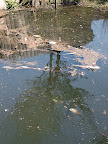
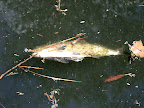
Here are photos of some fish left behind by the cleanup workers. The second one was huge - easily 2 feet long.
This weekend, we're staying with my brother in a condo in Goldsboro, NC. Behind his place, there is a small creek that is usually teeming with fish.
Apparently, just before our arrival, due either to dumping directly into the stream, or chemical or fertilizer use near the stream (and recent heavy rains), all the fish suddenly died. When we arrived, we saw workers cleaning dead fish from the stream. We're talking everything from tiny minnows to 3-foot long monsters.
Of course that's not where it ends: there is an egret that lives nearby and hunts for fish in the stream; there are geese that travel through here and stop to eat. The effects of this fish kill goes on and on. Who drinks or uses this water now tainted with rotting fish?
I searched around online and found that this is Goldsboro's unreported environmental disaster.
Here are photos of some fish left behind by the cleanup workers. The second one was huge - easily 2 feet long.
Tuesday, January 30, 2007
Movie Night
Here's something to do tonight: download a copy of the Freedom Fuels movie and give it to someone who needs to learn more about biofuels.
Be forewarned: Darryl Hannah licks the fuel cap of her El Camino. Yummy.
Be forewarned: Darryl Hannah licks the fuel cap of her El Camino. Yummy.

Monday, January 15, 2007
And now, the weather

After an oddly warm winter, the midwest has finally succumbed to winter's icy grip. It's been snowing since Saturday, and isn't supposed to stop until 1AM tomorrow. I'm thrilled.
Why does this matter when talking about cars?
My heat doesn't work, but after doing some reading (and several mentions from the comments section) about the problem, I'm pretty sure I know what I need to fix problem. I think the problem is in the monovalve - an electronic valve that controls flow of hot engine coolant to the passenger heating coils in Mercedes cars. The symptoms are similar to descriptions I've seen in several forum posts.
The parts will be here as soon as that free ground shipping can get them here. Hopefully, I'll be able to drive at highway speeds with the heat on soon enough.
I'm also getting a new sunroof switch, which is somewhat related. Prolonged summer weather means I'll need it.
Subscribe to:
Posts (Atom)